
Driveways, patios, sidewalks and slabs
Concrete Contractors in Fargo, ND
Concrete poured for Red River Valley clay and North Dakota winters, with a written quote before we start.
- Free on-site estimates with a base and drainage check
- Itemized written quote before any work begins
- Air-entrained mixes and planned control joints on every exterior pour
Concrete That Holds Up on Fargo Clay
Concrete contractors in Fargo work on some of the hardest ground in the country. The city sits on the flat bed of glacial Lake Agassiz, and a Fargo Forum report on local soils quotes retired NDSU geology professor Donald Schwert calling the Red River Valley "among the worst of construction conditions in the United States." Below the black topsoil are thick layers of plastic clay that swell when they get wet and shrink when they dry out. A driveway, patio or sidewalk here has to be built for ground that moves, and then for a winter that averages about 43 days at or below zero. That is what we plan for on every job.
What the clay and cold do to concrete
Clay that swells in a wet spring and shrinks in a dry August lifts and drops slabs a little at a time. Panels tip toward the house, joints open up, and low spots start to hold water. Then winter adds freeze-thaw cycles. Water that sits in a crack or in the surface of the concrete freezes, expands and breaks a little more off each time. Fargo's January average low is about 1 degree, and the city gets a little over 51 inches of snow a year, so there is plenty of water and plenty of freezing.
Streets get a sand and salt mixture from city trucks, and that brine rides into garages and onto driveways on tires. Salt does not hurt sound, properly cured concrete much, but it speeds up flaking (scaling) on surfaces that were finished wet, poured without air entrainment, or never sealed.
Our build standard for Red River Valley ground
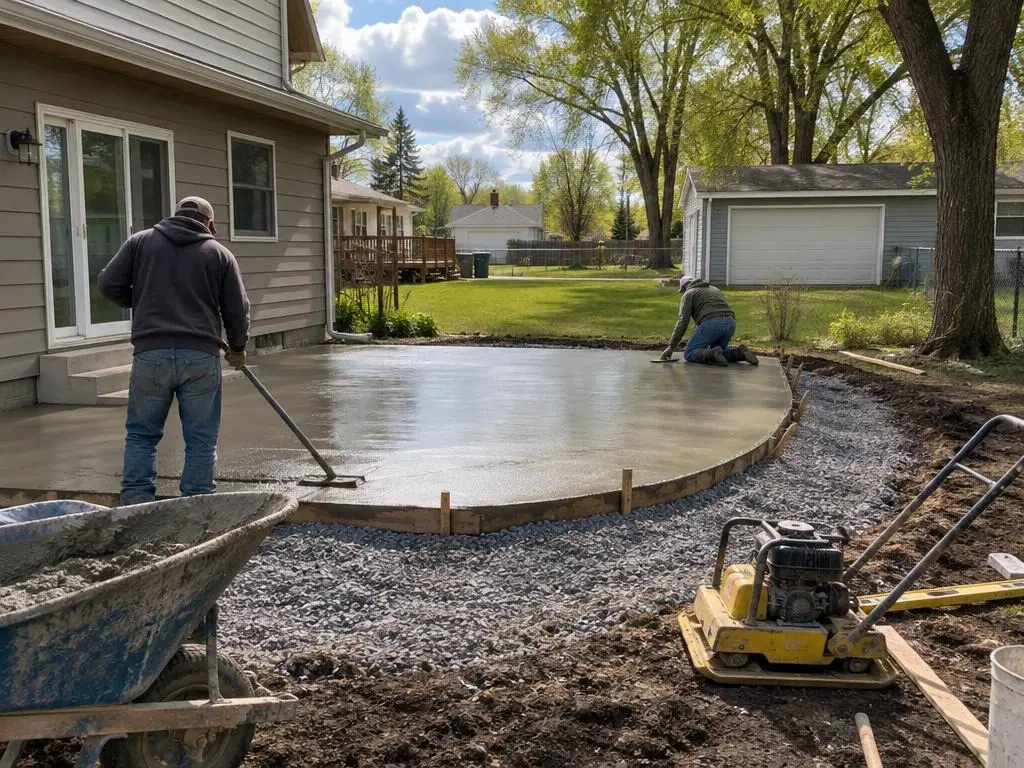
- Get off the clay. Organic topsoil and soft material come out, and crushed gravel is compacted in their place before any form goes up.
- Order the right mix. Exterior pours use air-entrained concrete; the microscopic voids it carries relieve the pressure when absorbed water freezes.
- Match steel and depth to the load. Rebar on chairs, extra depth where vehicles turn and park, and dowels wherever fresh concrete butts against an existing slab.
- Plan where meltwater goes. Every slab falls away from foundations and garage doors so April melt heads for the yard or the street.
- Decide where it cracks. Joints are laid out on paper and cut or tooled on schedule, giving shrinkage a straight line to follow.
- Cure it, then seal it. We keep the surface from drying too fast and hand you written first-winter care notes.
Old concrete, new neighborhoods
Fargo's housing spans more than a century. Census figures summarized by Point2Homes put the median Fargo home at 1991, with about 8 percent built before 1940 and roughly a quarter built between 1950 and 1979. Near downtown and around NDSU, plenty of driveways, alley garage aprons, front walks and steps are decades old and have taken a long run of winters. Since the mid-1980s most growth has pushed south and southwest toward newer subdivisions and West Fargo, where the concrete is younger but can sink where it crosses backfill around a foundation.
Those two kinds of property call for different work. Older homes tend to need tear-out and replacement, sometimes with a wider driveway or new steps at the same time. Newer homes more often want a patio added, a slab for a shed or a third stall, or a few sunken panels dealt with before they get worse.
City sidewalks and approaches
North Dakota law makes property owners responsible for building and maintaining the sidewalk next to their lot. The City of Fargo's Engineering Department inspects sidewalks and marks panels for replacement when a crack, a lip or pits reach a quarter inch, or when a panel slopes more than a quarter inch per foot or holds water. Fargo also requires anyone installing or repairing sidewalk in the right of way to be licensed with the City as a Sidewalk Contractor and to hold a North Dakota contractor's license, and unlicensed work can bring a $500 fine. Residential driveways must be between 9 and 30 feet wide where they cross the sidewalk line. We check these rules for your address before quoting, and we tell you which parts of the job fall under city rules.
Our services
New work covers driveways, backyard patios, stamped and colored concrete, front walks and steps, and garage and shed slabs. Repair work covers sunken panels, wide cracks, flaking surfaces and broken steps, along with full replacement when a slab is past saving. It all begins with a site visit and a written price. Call (701) 773-3206 or request a free estimate online.
Concrete Services in Fargo
Six kinds of work, each built for clay soil, frost and salt. Pick one to see what the job involves, typical costs and how we do it.
Concrete Driveways
New and replacement driveways set on compacted gravel, reinforced with rebar, poured air-entrained and pitched so meltwater leaves the garage.
Learn more →Concrete Patios
Backyard patios laid out for how you actually use the yard, on compacted gravel and pitched away from the house so spring melt stays out of the basement.
Learn more →Stamped Concrete
Patterned, colored concrete that looks like stone, brick, slate or wood, sealed to handle snowmelt and de-icers.
Learn more →Sidewalks & Steps
Front walks, stoops and concrete steps rebuilt level, with landings ready for a handrail, texture for icy mornings, and clear guidance on City-marked panels.
Learn more →Garage & Shed Slabs
Floors for new garages, shop additions and sheds, with thickened edges, a gravel base and drainage toward the door.
Learn more →Concrete Repair & Replacement
Honest advice on whether to fill, raise, resurface or replace cracked, sunken and flaking concrete.
Learn more →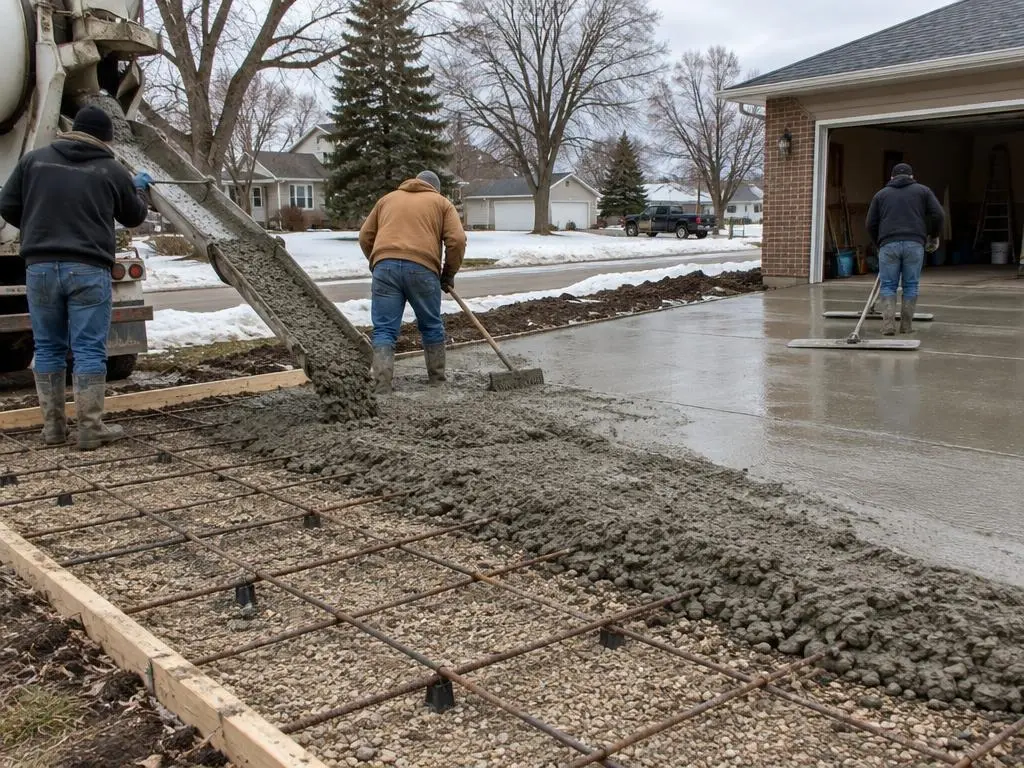
Where We Work
Our area pages cover Fargo itself, including Downtown, Oak Grove and Osgood, plus West Fargo, Horace, Harwood, Reile's Acres, Frontier, Oxbow, Mapleton, Casselton, Kindred and Argusville on the North Dakota side, and Moorhead, Dilworth, Glyndon, Sabin, Hawley and Barnesville in Minnesota. Each city sets its own sidewalk, approach and permit rules, so we look up the ones for your address before we quote.
- Concrete Contractors in Fargo, ND
- Concrete Contractors in West Fargo, ND
- Concrete Contractors in Moorhead, MN
- Concrete Contractors in Dilworth, MN
- Concrete Contractors in Horace, ND
- Concrete Contractors in Harwood, ND
- Concrete Contractors in Casselton, ND
- Concrete Contractors in Mapleton, ND
- Concrete Contractors in Kindred, ND
- Concrete Contractors in Oxbow, ND
- Concrete Contractors in Reile's Acres, ND
- Concrete Contractors in Argusville, ND
- Concrete Contractors in Glyndon, MN
- Concrete Contractors in Sabin, MN
- Concrete Contractors in Hawley, MN
- Concrete Contractors in Barnesville, MN
- Concrete Contractors in Frontier, ND
- Concrete Contractors in Osgood, ND
- Concrete Contractors in Oak Grove, ND
- Concrete Contractors in Downtown Fargo, ND
Why Homeowners Call Concrete Contractors Fargo
Base before finish
Most slab failures on clay begin below the surface, so soft soil comes out and compacted gravel goes in before we talk about finishes.
Mixes for freeze-thaw
Exterior concrete gets an air-entrained mix and a proper cure, the two things that do the most to stop winter scaling.
City rules checked first
We look up sidewalk, approach and permit requirements for your address and tell you before work is scheduled.
A written, itemized quote
Thickness, base, reinforcement, finish, tear-out and total, all on paper before we start.
Common Questions
What does a new concrete driveway cost in Fargo?
HomeGuide's driveway guide puts standard to basic concrete at $6 to $15 a square foot nationally. On that scale a 20 x 20 two-car pad lands around $2,400 to $6,000, and breaking out an old driveway adds roughly $2 to $6 a square foot. Base depth on clay, thickness and access move the Fargo number, so the written estimate is the figure to plan on.
Why does concrete crack so much in Fargo?
Two reasons. The Lake Agassiz clay under the city swells when wet and shrinks when dry, which moves slabs. And the winter freezes water in the concrete over and over. Good base prep, air-entrained concrete and well-placed control joints keep cracks small and in the joints.
What months are best for pouring concrete in Fargo?
Most exterior pours here happen between late spring and early fall, once the ground has thawed and nights stay above freezing. Cold-weather pours are possible with heated water, accelerating admixtures and insulated blankets, but they cost more and leave less margin, and we will not place concrete on frozen ground.
Is a permit needed for concrete work in Fargo?
That depends on where the work is. Sidewalks and approaches in the City right of way fall under the Engineering Department and must be done by a contractor licensed with the City as a Sidewalk Contractor, and driveways have to fit the City's width limits at the sidewalk line. We look up what applies to your address and job before anything is scheduled.
Should I repair or replace my concrete?
Narrow cracks and a few sunken panels are usually worth sealing or lifting. HomeGuide's leveling and resurfacing guides point to replacement once cracks wider than a quarter inch spread across the slab, spalling is heavy, or the concrete is breaking apart. After we see it, we tell you which side of that line it falls on.
How long does new concrete need before I can drive on it?
Walking on it is usually fine after a day or two. Give it about a week before a car parks on it, longer for heavy pickups or trailers. Full strength takes roughly four weeks, and cold weather stretches every one of those times.
Should I seal my driveway or patio?
Yes. A penetrating sealer slows salt brine and meltwater from soaking into the surface, which is what drives scaling here. HomeGuide prices sealing at about $1 to $3 a square foot and suggests redoing it every 2 to 3 years.
Get a Free Concrete Estimate in Fargo
Describe the driveway, patio, walk or slab. We will measure on site, look at the base and drainage, and put a written price in your hands.